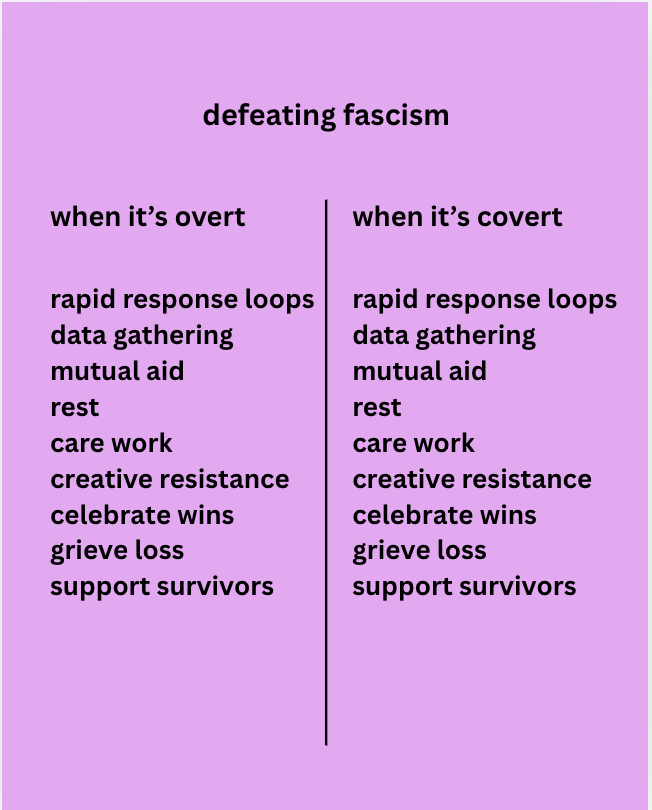
“There are two sides to this struggle: rapid response and mutual aid. Rapid response networks organize to identify and track ICE vehicles and agents and to disrupt abductions in process. Mutual aid networks organize to get affected people food, medical care, vet visits, company…whatever they need. These are two separate webs of networks. The mutual aid side is more secretive in its organizing, of course, because it is taking care of the people who cannot leave their homes without being kidnapped. It’s strange to realize that the work people can do aboveground is harass federal agents, but the work people have to do in secret is…feed people.” –Margaret Killjoy, “Our Neighbors in Minneapolis,” on margaretkilljoy.substack.com
It’s a big moment for Minnesota. There are steadily expanding boycotts, mutual aid groups, rapid response networks, and strikes. The state is making headlines for using all these tools to resist Operation Metro Surge, which is essentially a federal occupation of the state by thousands of ICE agents who are terrorizing the population by detaining, kidnapping, and killing people in the street.
While people in this state are extremely stressed by the horrible violence, the news from Minnesota is ironically giving hope to the entire country that we have the tools to defeat the fascist takeover of the US.
Waziyatawin, a Dakota author and activist who writes about transformative justice in North America, suggests that it is possible to restore peace to the people of this continent by meeting their needs outside of the systems that oppress them. Providing the basis for all human needs to be met in community eventually makes capitalist systems redundant and unable to force dependence. Her work has roots in this land and Indigenous communities here show the newcomers how to practice it.
First, there has to be a recognition that the system is harmful and not supporting the survival of the population. As in 2020, but more so with every killing by ICE and Border Patrol, the justice system is recognized not to deliver justice in this state. The regular people who live here are angrier than ever about the continued killings. And while angry, in the coldest time of the year, people are acting collectively to do things that feel more meaningful, to resist the occupation of the city and protect each other, so that there is evidence to see with our own eyes that we are able to make something better than the systems we are presented with.
The strikes in Minnesota are a huge step outside the box of the established system and status quo. Drawing strength from the state’s last general strike of 1934 and the uprising of 2020, the marches and actions on Friday, January 23rd in sub-zero weather made history. The strike quickly spread to other states, and the following Friday and January 30th was declared a strike day as well.
Strikes disrupt capitalism. But when stores are shut down, there has to be something else to meet the needs of people. Grocery distribution sites popped up in every neighborhood, as they did in 2020. My Huang Kitchen on Nicollet Avenue is inviting people in to warm up and have free soup all day on strike days. Modern Times Cafe declared that it would not charge money for food until the occupation ends, and changed its name to Postmodern Times. Many Mexican and Latin restaurants such as Los Ocampo had to close temporarily due to safety concerns. Fundraisers are being shared to support the workers and bring groceries for sheltering in place. Schools are organizing safety patrols for pickup and dropoff times, and neighbors are giving rides to work for those who are most vulnerable.
The rapid response chats on Signal that bring neighbors and commuters quickly to stop abductions by ICE were first established in 2020 after the murder of George Floyd. People here tend to call on each other rather than calling on the police, thanks to organizations like Relationships Evolving Possibilities that came out of the uprising. The victories were built on the work done by those on the frontlines then, and will belong to everyone who has resisted since that time. Every single person here in this state has a say in how this plays out right now. What hurts you most about the federal occupation of this city? Which moments, and which details, enraged you the most, and radicalized you to work for something better? What do you want most for your life, and what do you want for your loved ones?
There are vast injustices built into the US justice system. Black and Brown people have known this. The increased activity on the part of ICE has served to bring some major longstanding problems into public view. The violence of these masked federal agents can no longer be denied. And the profit motive is more clear than ever before. The majority of ICE detainees are held in private prisons, and contracts specify that the facilities must be filled. The increased abductions we are seeing have been prompted by the private prison industry, among other industries that also benefit. Enterprise, Amazon, Ecolab, and local businesses have contracts with ICE. And those contracts can be changed, just as the hotels are deciding one by one that they would rather tell ICE to go elsewhere rather than get bombarded with festive resisters in the middle of the night.
ICE is a paramilitary group created to prey on marginalized people in order to serve a ruling class who already control most of the wealth in the country, and want to control more. In a nightmarish twist, survivors of the Trump-Epstein child abuse rings are revealing that this same ruling class distinguishes itself with a preoccupation with the sex trafficking of minors. It is easy to feel more and more upset thinking about the extent of the injustice.
On the other hand, any feeling of helplessness is contradicted by the undeniable power of those who have survived the worst of the violence that is happening. Latinx immigrants and East African communities targeted directly by Trump and persecuted relentlessly by ICE have taken the lead in organizing ways to keep people safe. They are accelerating the creation of new systems and practices to meet people’s needs without relying on any of the institutions that are tied to the occupation.
This week, so much is happening. Detainees are rising up in fury within the detention center where 5-year old Liam and his father are being held. Survivors of sex trafficking are naming their abusers, when their abusers happen to be the richest men on Earth. And immigrants who are the most vulnerable are setting up food distribution centers that outdo capitalist grocery stores in their efficiency and agility.
Minnesota is being targeted by ICE because of who is valued here and the fact that it is the best example in the country of a functioning welfare state. As in the struggles of the past, those who are targeted are in a position to know what is most needed to get out of this mess.
It’s a terrible time for Minnesota in the sense that the occupation brings horrendous violence every day and we are all struggling. But this crisis just might be the one that breaks us out of this system. When survivors lead the way to identify the violence and its source…and more people begin to put all their skills into resisting this occupation, ready to walk out of work and pour into the streets to mourn together after someone is killed…and those who can’t come out are making the art and food to help us keep going…the power of transformative justice is close at hand.
If you would like any assistance with any aspect of transformative justice work, such as tips on forming a pod, to work toward any type of justice or healing for you personally or for a loved one, a reading list, or ways to use your skills to help the movement for justice in Minnesota or elsewhere, feel free to email us at minnesotatransformativejustice@gmail.com.